Benjamin App
Rooted in the belief that loyalty should feel effortless, Benjamin transforms everyday spending into rewarding experiences, merging the trust of card-linked cashback with the simplicity of no-hassle design.
From Routines to Rewards, Building Loyalty Through Design
Benjamin is a US-based fintech product designed to strengthen loyalty between local businesses and their customers through effortless, card-linked rewards. In its earliest version, the product focused on delivering cashback when users shopped at stores—no coupons, no hassle. The MVP was built to feel trustworthy, simple, and rewarding, laying the groundwork for what would later evolve into a broader “money moments” experience.
The Start
When I joined Benjamin, there was no product—just a vision. A small team believed that helping users earn cashback from everyday purchases could foster loyalty between local businesses and their customers in the U.S.
My role was clear: I was to bring this idea to life from the ground up. As the only designer, I worked closely with the founders, engineers, and marketing team to shape an experience around a core mechanism—cashback made possible through card linking.
Four months later, in January 2023, we launched. I want to sit with that for a second—four months, no existing product, one designer. That timeline meant making hard calls daily: what we designed fully, what we shipped at 80%, and what we deliberately left for later. There was no room for indecision. I had to move fast enough to keep pace with engineering while making design decisions I could stand behind in production. The pressure sharpened something in me—a bias toward clarity, toward shipping something real rather than perfecting something hypothetical. [Edit: add anything specific you had to cut or deprioritize to hit that timeline, and what that felt like as the only designer.]
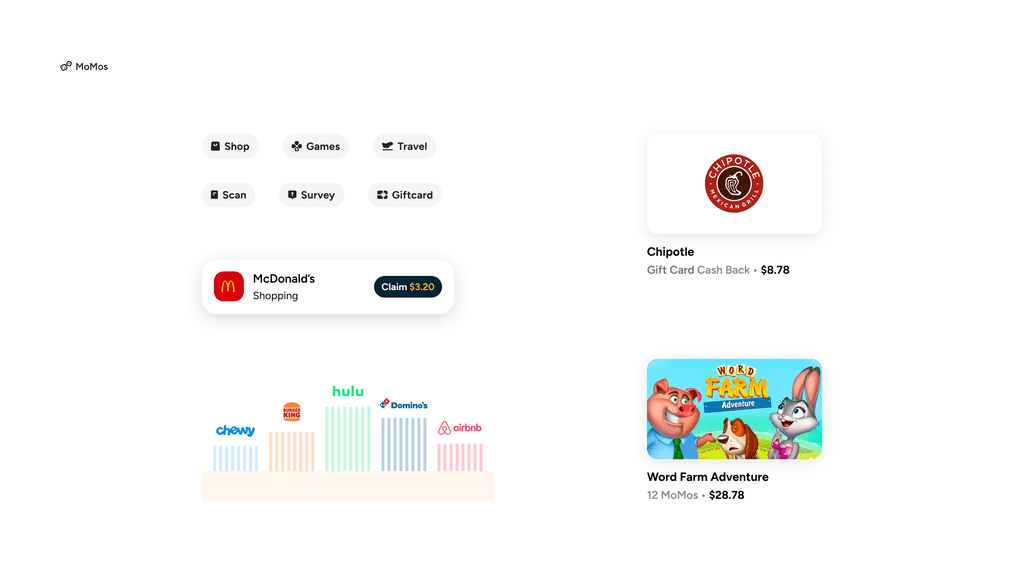
By January 2024, after a successful seed raise of $5.5M, we began expanding that vision—turning everyday moments like playing games or scanning receipts into meaningful earning opportunities.
The Challenge
This wasn’t just about building a cashback app. We were trying to create a behavior change:
- For customers, trust a brand-new app with your card.
- For businesses, believe in a system that would drive loyalty and not just transactions.
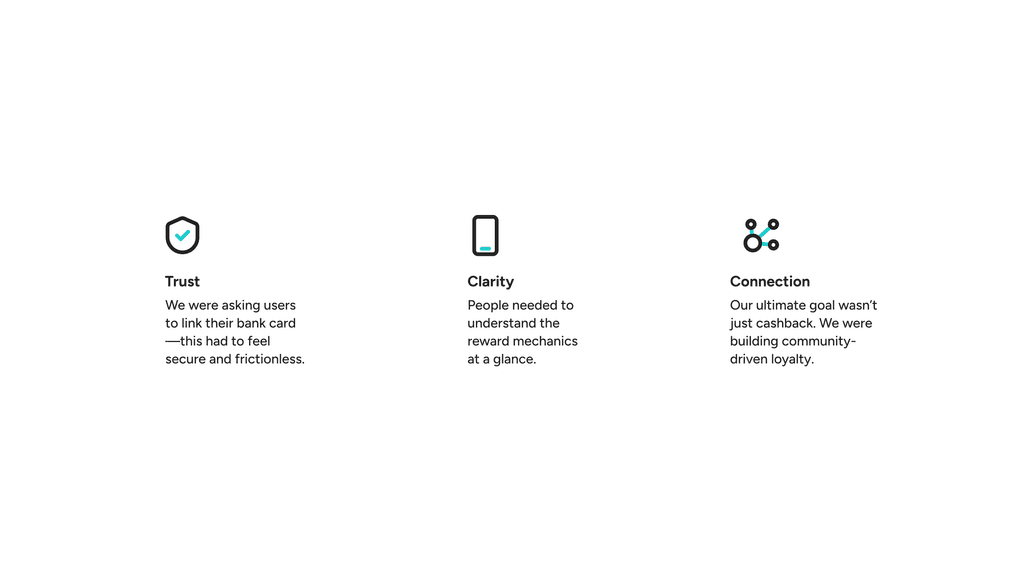
There were three main challenges:
Designing Trust, Earning Loyalty
Benjamin’s MVP had one mission: make earning cashback feel effortless and trustworthy. But asking users to link their bank cards wasn’t trivial—we had to earn their confidence from the very first screen. I led research into what drives engagement with cashback apps and uncovered three essentials: clarity, speed of reward, and trust. The core experience was simple:
- Seamless card-linking during sign-up
- Shop at a store (in-person or online)
- Earn cashback (and get notified)
- Withdraw with ease
Early data told us something was broken: only 30% of users were successfully linking their cards. Without a linked card, the product simply didn’t work, no card, no cashback. The problem turned out to be trust, not usability. Instead of making the step optional, I redesigned it to earn the ask, and card-linking success rose from 30% to 90%.
The full story, from the research to the fix that didn’t work, is in its own case study: Card linking.
From Discovery to Daily Habit
After launch, we noticed a critical gap: users weren’t finding the Offers tab—and without that, they weren’t earning. It wasn’t a product issue. It was a visibility issue. I led a redesign of the home screen to guide users into action from the moment they opened the app:
- Surfaced personalized offers directly on the homepage
- Highlighted limited-time deals to spark urgency
- Visualized progress toward reward milestones
But the home screen alone wasn’t enough. We needed to meet users where they already were—not just inside the app. So we expanded the earning surface across three new touchpoints.
Browser Extension
The insight was simple: users were already shopping online, they just weren’t thinking about Benjamin while doing it. The browser extension was designed to surface cashback opportunities at the exact moment of purchase intent—without interrupting the shopping experience. The design challenge was restraint. An extension that nagged or cluttered every tab would be uninstalled within a week. I focused on making it feel like a quiet assistant: visible only when it was relevant, and invisible when it wasn’t. The notification appeared contextually on partner sites, with a single clear action—activate cashback—rather than a wall of options. [Edit: add what the trigger looked like, and any A/B tests or iterations you ran here.]
Gaming Hub
Adding games to a fintech app is a risky move. Done wrong, it feels cheap—like the product has lost confidence in its core value. The design challenge was making the Gaming Hub feel like a natural extension of the earning experience, not a distraction from it. I anchored every game to a reward outcome: before playing, users could see exactly what they stood to earn. That framing kept it connected to the product’s core promise. The games rewarded time and engagement rather than spending, which opened Benjamin up to users who weren’t frequent shoppers but still wanted to participate. The hub saw a 30% boost in activity within the first month. [Edit: add what the design of the hub itself looked like, any decisions around game selection or session length, and what you learned from early usage.]
Loyalty Program
Loyalty tiers are everywhere in fintech—and most of them feel meaningless. Users advance through levels that sound impressive but deliver nothing tangible. My goal was to design a tier system that felt earned, not manufactured. Each tier had to offer something users could actually feel: higher cashback rates, faster withdrawals, early access to deals. The visual design of progress mattered too—I wanted the distance to the next tier to feel motivating rather than discouraging, so I spent time on how progress was communicated: not as a percentage, but as a concrete milestone. “Earn $10 more cashback to reach Gold.” Specific. Actionable. Within the first month, 70% of users had advanced at least one tier. [Edit: add how you decided on the number of tiers, what each tier unlocked, and any research or testing that shaped the design.]
Together, these three features turned Benjamin from an app users opened after they shopped into one they engaged with throughout their day—leading to:
- 50% increase in daily active users
- 30% boost in Gaming Hub activity
- 70% of users advancing in loyalty tiers within one month
- 60% increase in monthly revenue
By making rewards easier to find—and more fun to earn—we turned discovery into habit.
Building for Growth, Loyalty, and Real Impact
A few months after launch, the retention numbers came in—and they stopped us in our tracks:
- Day 1 Retention: 88%
- Day 7 Retention: 51%
- Day 14 Retention: 40%
- Day 30 Retention: 30%
To put those in context: Day 1 retention of 88% is exceptional for a fintech app. The industry average sits far lower—most consumer fintech products struggle to keep even half their new users past the first day. Day 30 at 30% meant nearly a third of every new user was still coming back a month later. These weren’t vanity metrics. They told us people had made Benjamin part of their routine.
The product worked because we designed for behavior, not just for use.
If I could go back, I’d have pushed harder earlier on the card-linking education—we left value on the table in those first weeks before we diagnosed the drop-off problem. I’d also have invested more time in the onboarding experience for the Gaming Hub; we shipped it quickly and had to iterate more than I would have liked. [Edit: replace or add your own honest reflection on what you’d do differently—this is the part that will stick with a senior hiring manager.]
What I carry from Benjamin isn’t just the numbers. It’s what it taught me about designing under constraint—how a tight timeline and a single-person design function forces you to get ruthlessly clear on what matters. How trust, once earned through design, compounds. And how the most interesting design problems aren’t about the interface at all—they’re about the behavior you’re trying to shape, and whether your product genuinely earns a place in someone’s life.